Choosing the Right Access Credentials for Your Ecosystem
Which access credentials are the right fit? The key factors are your infrastructure, user groups, lifecycle, and security requirements.
Posted by
Lizelle Maas
Posted date
September 18, 2026

Which access credentials are the right fit? The key factors are your infrastructure, user groups, lifecycle, and security requirements.
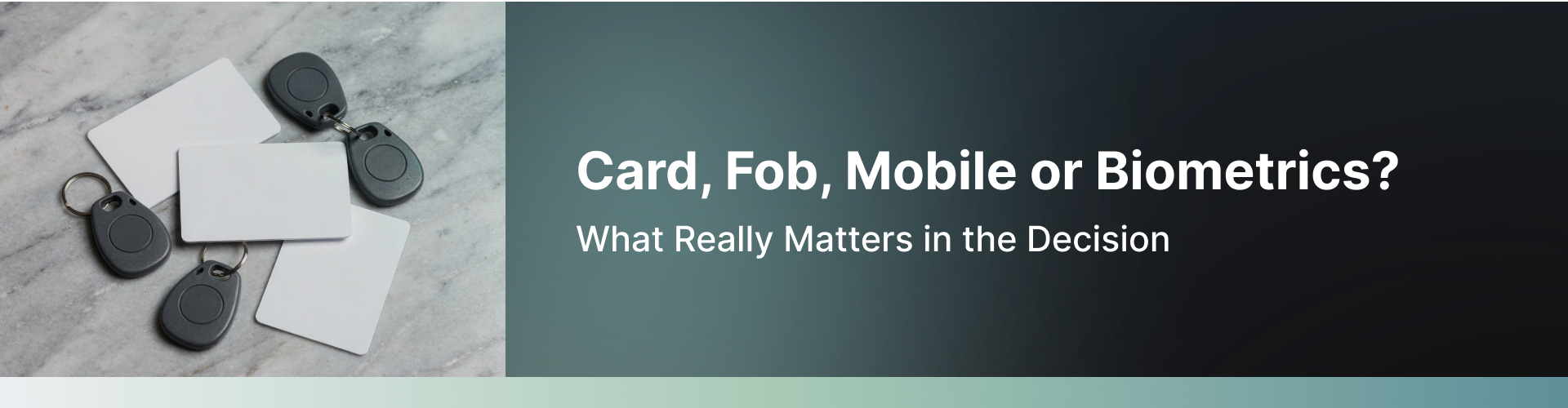
Most credential conversations begin with the object someone will carry to gain access to something. Should employees continue using cards? Is mobile worth introducing? Would biometrics improve security in sensitive areas? And with FIDO2 becoming more relevant, should physical and digital authentication start to converge?
These are all fair questions, but they make more sense once the wider ecosystem is understood.
A credential sits inside a larger identity and access ecosystem. Its usefulness depends on the people using it, the readers already installed, the systems it needs to interact with, the level of assurance required, and the way it will be issued, changed and revoked over time.
A card, phone, key fob or USB security key describes how someone carries an access credential. The access and security model sits behind it.
Three cards that look almost identical can support very different technologies. One may be used purely for physical access. Another may support encrypted authentication. A third may combine building access with authentication for digital systems.
FIDO2 makes this especially relevant. It is often associated with USB security keys used for passwordless or multi-factor authentication, but FIDO2-capable credentials are also available in card form. That creates the possibility of using a single physical credential for both physical and digital access.
That can simplify the user experience, but it also raises new questions around reader compatibility, provisioning, lifecycle management, and responsibility across physical and digital systems.
A ‘simple’ employee card can now represent a much more complex authentication architecture.
Different areas rarely carry the same level of risk.
Access to a general office area may only require a valid company credential. A laboratory, data center, high-voltage production area, or other sensitive zone may require stronger assurance that the person presenting the credential is really the person it was issued to or that they have the necessary qualifications or clearance to enter that area.
Some areas may therefore work well with a single credential, while others justify a second factor, like a PIN or biometric verification. Digital authentication may introduce another level of assurance again.
The credential strategy should reflect these differences rather than forcing the same authentication approach everywhere.
Existing infrastructure has a major influence on what is practical.
An organization with thousands of readers across offices, production sites, turnstiles, and remote locations has to consider the age, configuration, and capabilities of that estate before introducing a new credential technology.
A proposed credential may require significant reader replacement. In other cases, existing hardware may already support additional technologies or may be capable of being updated.
This becomes particularly interesting with FIDO2. As we covered in our article on FIDO2 and reader updates, some existing reader environments may be updated rather than replaced, although the credential itself also needs to support the required functionality.
That difference can change the scope of a project considerably. Reader replacement affects installation, testing, downtime, and coordination across sites, not only hardware cost.
In a large organization, moving to a new credential technology rarely happens all at once. Replacing thousands of cards and readers across multiple sites can take months or even years. During that period, the old and new environments need to work alongside each other. Some locations may already support the new credential while others still rely on the existing one. Employees who move between sites may therefore need access to both environments, and new credentials may need to remain compatible with older readers.
This is where migration planning becomes important. The organization needs to decide which sites or user groups move first, how long both technologies will remain active, and when the older credential can finally be retired.
A credential may be ideal for the future environment, but it also needs a practical route into the infrastructure that exists today. That transition should be considered before the technology is selected.
Issuing a credential is usually the easy part. Keeping it aligned with the identity behind it is harder. People change roles, move sites, lose cards, replace devices, complete training and leave the organization. Contractors have end dates that change. Visitors return. Each of these events can affect access.
This becomes even more important when one credential supports several functions. If a card is used for both building access and digital authentication, losing it can affect multiple systems at once. This is where credential management and PIAM meet directly. The credential remains trustworthy only while the identity, permissions, and lifecycle behind it remain accurate.
Standardizing everyone onto the same form factor is not always useful.
Permanent employees may benefit from personalized smart cards that provide both access and visible identification. Contractors may use the same credential technology but often have different lifecycle requirements because their access is linked to contract periods, training, or certification status. Visitors may be better suited to reusable badges or mobile credentials, depending on how they are managed.
Key fobs remain useful where durability matters and visible identification does not. Biometrics can provide stronger assurance in selected high-security areas, although privacy, reliability, and organizational acceptance must be considered.
Many mature environments therefore use several credential types deliberately. The consistency comes from how identities and permissions are governed across them.
A useful credential strategy should also work when something goes wrong or needs to change suddenly. What happens when an employee loses a card before an early shift? When a company phone fails? When a contractor is extended at short notice? When an employee needs access to another site? When a certification expires overnight? These situations quickly expose operational weaknesses.
If every exception requires manual intervention or specialist knowledge, the burden can outweigh the benefits of the credential itself. If lifecycle processes are well integrated, the same situations become much easier to manage.
RFID cards, key fobs, mobile credentials, biometrics and FIDO2-capable authenticators can all be appropriate.
Their suitability depends on the ecosystem around them. The reader estate determines what can be introduced easily. The risk of each environment influences the level of assurance required. Different user populations have different operational needs. Lifecycle processes determine whether access remains accurate over time.
A good credential strategy therefore begins with the ecosystem, the identities moving through it and the changes that environment will need to support. The credential choice follows from there.