Is it all about ID functionality?
From a village dairy founded in 1896, a global corporation emerged: Today, the Theo Müller Group stands for innovation and high quality standards in the food industry.
Posted by
Thomas Ehm
Posted date
May 26, 2026

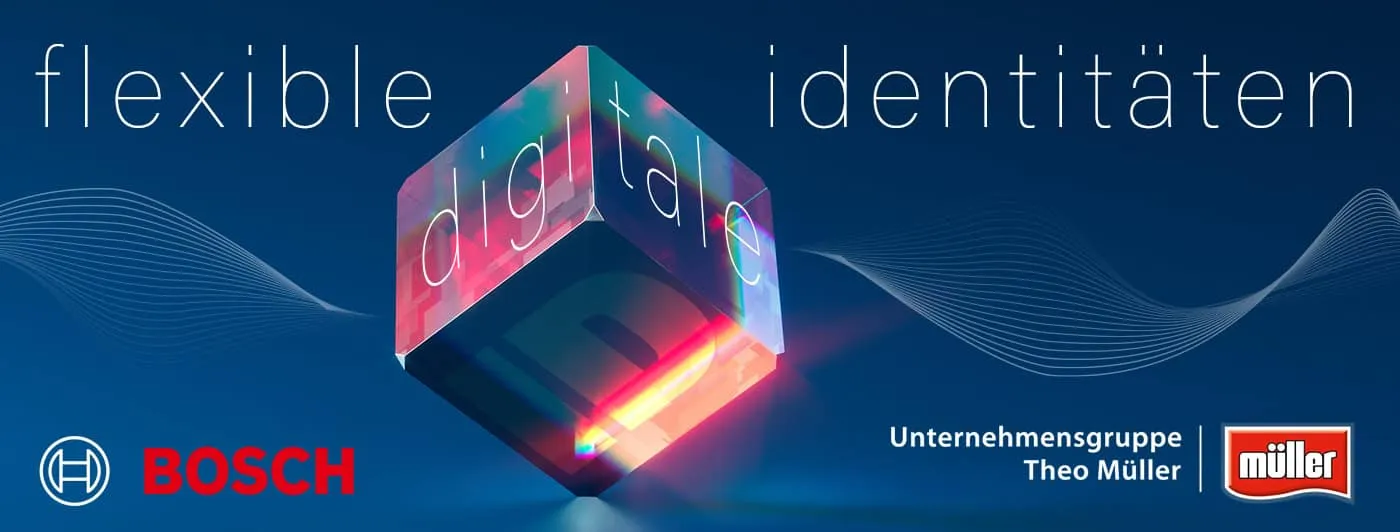
From a village dairy founded in 1896, a global corporation emerged: Today, the Theo Müller Group stands for innovation and high quality standards in the food industry.
PROJECT REPORT:
What started as a small village dairy, founded in 1896 in Aretsried, Bavaria, grew into a globally operating company: Innovative product policies, high quality standards, and shrewd marketing have the Theo Müller Group a major player in the food industry. And when there's a craving for flexible digital identities, the group relies on products and strategies from evolutionID.
Müller's trendy and popular dairy products are now produced at 19 locations worldwide. Currently, more than 26,000 employees generate an annual turnover of approximately 5.9 billion Euros. The production facilities operate around the clock, 365 days a year. At the Leppersdorf site alone, five million liters of milk are processed daily. “The Theo Müller Group has grown at an enormous pace in recent years – partly due to acquisitions,” explains Hendrik Grempe, Head of Real Estate & Business Services at the Theo Müller Group. “This sometimes led to a rather heterogeneous IT infrastructure, which now also needed an update in terms of security,” says Hendrik Grempe, “and the entire handling needs to become simpler, more secure, and more cost-effective.” Through the existing partnership with Bosch Energy and Building Solutions contacted evolutionID and, during an extensive consultation process, was convinced of the benefits of a centralized digital identity management system. „Production interruptions due to an IT system changeover are not an option for us“, states the Theo Müller Group. A rollout during live operation was therefore an important part of the requirements specification. Thus, the two sites Leppersdorf (3500 employees) and Aretsried (1500 employees) were initially switched to new security badges. switched over. The software foundation is an IDfunction-Server at the Leppersdorf site. The flexible ID management system retrieves employee master data from the SAP infrastructure and enriches it with information and authorizations. This creates a digital identity for each employee, which now serves as a central instance supplies all other security-relevant systems. For example, IDfunction manages access authorizations, time tracking data, secure print features, or payment information for the company canteen. If a badge is lost or an employee leaves the company, all authorizations can be revoked with just one click. The system operates with an ergonomic web interface and is thus largely device-independent. The central data repository is accessed by Administrative and production workstations at remote locations . Here, not only data is entered, but also personal photos are taken and the new RFID cards are printed and configured. This relies on modern multi-standard transponders, which work equally well with both already renewed and existing readers. Meanwhile, more than 6,000 of the new cards are in smooth operation. "Both the system and the service provider evolutionID have proven that the concept is viable and implementable," praises the project team. "Step by step, we will convert all locations to the new centralized digital identity." For the future, Müller Milch plans further enhancements for the ID management system. "In the future, employees will be able to use their employee ID card for many services, including machine control," says Mr. Grempe, "but of course, only if they are trained and authorized to do so. This way, we guarantee maximum security standards – for our products and for our employees!"